Design Verification resume guide
Build a DV resume that clears the ATS and convinces the hiring manager
A proven, ATS-friendly playbook for design-verification engineers: how to structure every section, the exact keywords recruiters screen for, and how to turn your work into quantified, interview-ready bullets — plus three domain templates, one for every career stage.
Principles & format
- Use a reverse-chronological layout — it is what DV recruiters and ATS parsers expect.
- Keep it tight: 1–1.5 pages early-career, 2–3 pages once you are senior.
- Stick to clean fonts (Arial, Calibri or Times New Roman) at 10–12pt with 0.5–1" margins.
- Submit both a .docx and a .pdf — some portals parse one better than the other.
- Name the file FirstName_LastName_Resume.pdf, not resume_final_v3.pdf.
Section order
Lead with what a DV screener looks for first.
- 1Contact information
- 2Professional summary or objective
- 3Technical skills
- 4Professional experience
- 5Education
- 6Optional: projects, certifications, publications
Show, don't tell
Every experience bullet should follow one formula: action verb + technical detail + quantified result + business impact.
Experienced in SystemVerilog and UVM.
Developed a UVM testbench in SystemVerilog for a PCIe Gen4 controller, reaching 98% functional coverage and catching 15 critical bugs before tapeout.
Responsible for running regressions.
Optimized the nightly regression with parallel execution, cutting runtime from 24h to 8h while raising coverage 40%.
Keywords recruiters screen for
ATS filters match exact terms. Use both the acronym and the full name, and only claim what you can defend.
Hardware description languages
- SystemVerilog
- Verilog
- VHDL
- SystemC
Verification methodologies
- UVM (Universal Verification Methodology)
- Constrained-random verification
- Coverage-driven verification
- Assertion-based verification (SVA)
- Formal verification
Simulators & debug
- Synopsys VCS / Verdi / VC Formal
- Cadence Xcelium / JasperGold
- Mentor QuestaSim / Questa Formal
- Coverage: IMC, URG
Scripting & programming
- Python
- Perl
- TCL
- Shell
- C/C++ (DPI & reference models)
- Makefile
Protocols & interfaces
- AMBA AXI/AHB/APB
- PCIe
- USB
- DDR3/4/5
- Ethernet
- SPI / I2C / UART
Design areas
- CPU / GPU
- SoC
- IP blocks
- Memory controllers
- AI/ML accelerators
Playbook by experience level
Match the emphasis to where you are — the three templates below are built around exactly these.
Entry-level (0–2 yrs)
- Academic projects & coursework
- Internships and co-ops
- Personal / open-source contributions
- A strong technical-skills foundation
e.g. "Implemented a RISC-V processor verification testbench in UVM, achieving 95% code coverage."
Mid-level (3–7 yrs)
- Specific technical achievements
- Ownership of verification projects
- Mentoring junior engineers
- Process & runtime improvements
e.g. "Led verification of a PCIe Gen4 endpoint IP, delivering bug-free to silicon in 18 months."
Senior / Principal (8+ yrs)
- Strategic project leadership
- Methodology & architecture definition
- Team management & mentoring
- Cross-org influence and impact
e.g. "Architected a verification methodology adopted across 5 product lines, cutting verification time 30%."
Section-by-section tips
Professional summary (3–4 lines)
- Lead with your title, years and strongest methodology
- Name one or two headline results — tapeouts, coverage, bugs
- Close with your specialism: UVM, formal or post-silicon
Technical skills
- Group by category, not one long comma list
- Order categories by relevance to the target role
- Be honest about proficiency — you will be grilled on every line
Professional experience
- 3–5 achievement bullets per role
- Start each with a strong action verb
- Quantify: coverage %, bug counts, runtime, schedule
Education
- New grads: GPA (if 3.5+), coursework, projects, honors
- Experienced: degree, university and year only
Projects (optional)
- Format: Name | technologies | duration, then contribution bullets
- The best lever for entry-level and career-changers
- Always quantify the outcome
Common mistakes to avoid
Technical
- Vague tool mentions — say how you used each one
- No numbers — always quantify coverage, bugs, time saved
- Listing outdated tools instead of current industry standards
Format
- Dense text walls — use bullets and white space
- Inconsistent dates, fonts and spacing
- Spilling past 2 pages when you do not need to
Content
- Passive voice — lead with action verbs
- Listing duties instead of achievements
- One generic resume for every posting
Beat the ATS
Keyword strategy
- Pull exact terms from each job description
- Integrate them naturally — never keyword-stuff
- Include both "UVM" and "Universal Verification Methodology"
Formatting
- Avoid tables, columns, text boxes and graphics
- Use standard headers: Experience, Education, Skills
- Confirm whether the portal wants PDF or Word
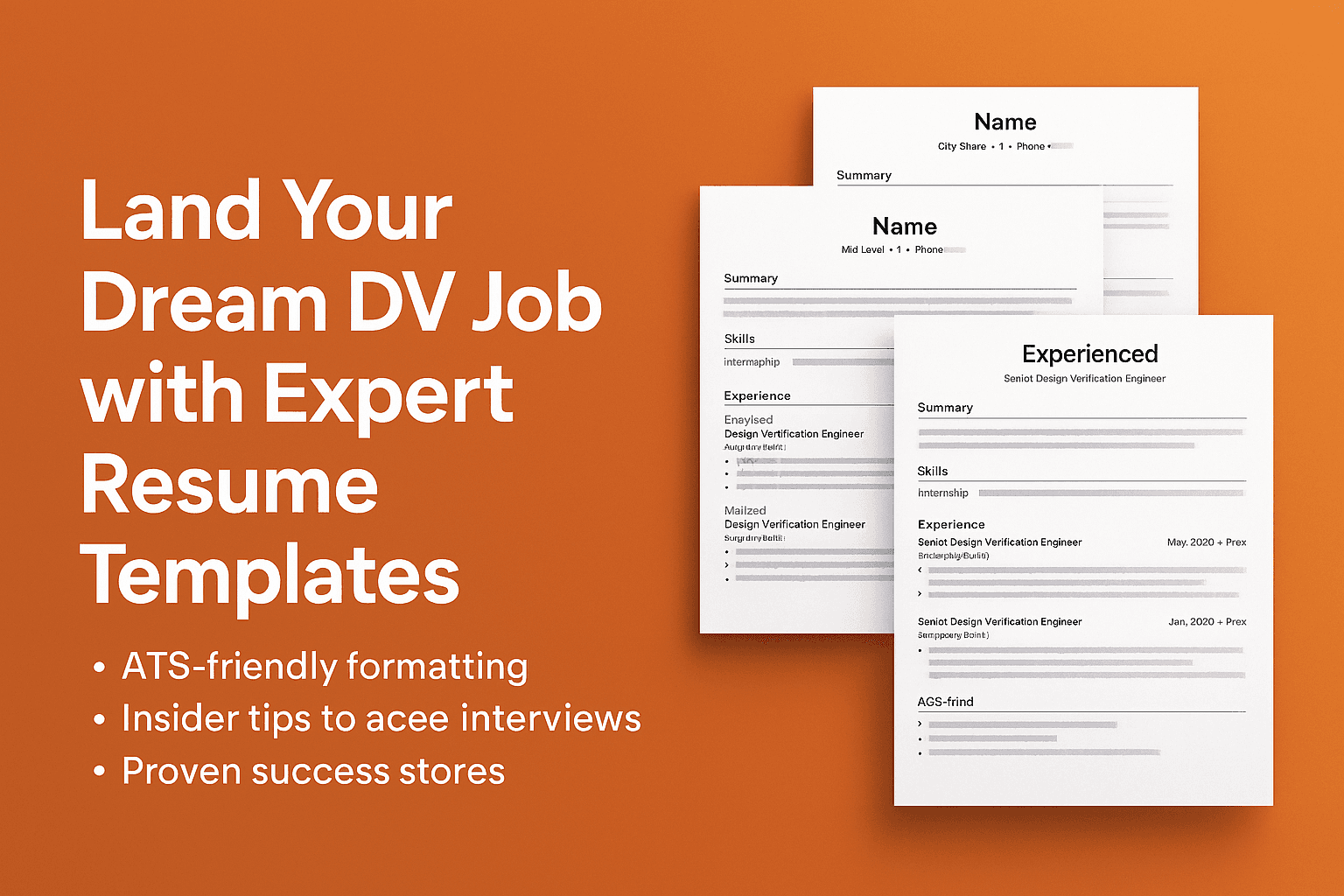
Domain resume templates
Fill-in-the-blank .docx templates for every career stage, tuned for design-verification roles. Included with the domain pack and All-Access.
Entry-level
For new grads and early-career DV engineers — lead with projects, internships and a strong skills foundation.
- Objective + categorized technical skills
- Academic projects with coverage & bug metrics (RISC-V, DDR4, SPI)
- Internship and relevant-coursework sections
- Certifications, open-source and publications blocks
- Entry-level do's and don'ts baked in
Mid-level
For engineers with a few tapeouts — balance deep technical results with early leadership and mentoring.
- Results-first professional summary
- Full DV skills matrix incl. formal & version control
- Achievement-driven experience with quantified impact
- Key-achievements and publications sections
- Guidance on showing career progression
Senior / Principal
For leads and architects — foreground strategy, team leadership, methodology and business impact.
- Executive summary + core-competencies block
- Leadership-scale experience (team size, budget, tapeouts)
- Strategic achievements, standards & publications
- Industry-recognition and continuing-education sections
- Principal-level framing and success factors
Get your resume reviewed
Once it's drafted, have a mentor tear it down line by line — the exact fixes recruiters look for — before you apply.